How to isolate a turntable from vibration Cabinet, speakers, floor and level: what to do so the stylus reads only the record
Boom, muddled bass, the stylus skipping when someone walks by: it is almost always vibration. Here is where it comes from and how to stop it, starting with the simplest fixes.
Why a turntable is so sensitive.
The stylus reads movements of a few thousandths of a millimetre cut into the groove. It cannot tell the groove from everything else: if the cabinet vibrates, if the floor moves under footsteps, if the bass from the speakers makes the top shake, the stylus reads that too and sends it to the amplifier.
The result can be boomy bass, a muddled sound, the stylus skipping when someone walks by. In the worst cases you get feedback: the sound from the speakers makes the turntable vibrate, the stylus picks it up, the amplifier sends it back to the speakers and the boom grows.
A rigid, heavy cabinet.
The first line of defence is the cabinet. It should be stable, not wobble when you touch it and not bend under the weight. A light cabinet or one with thin shelves acts like a sounding box; a solid wood cabinet, with thick, well-jointed shelves, damps vibrations instead of amplifying them.
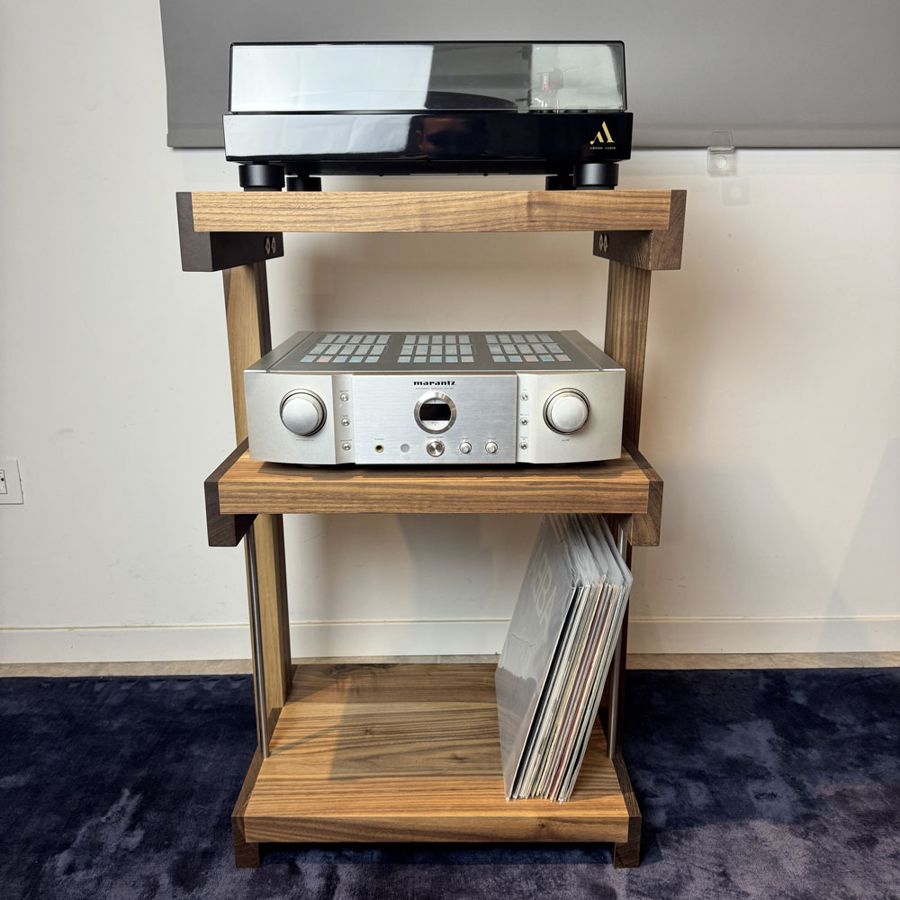
The turntable is best on the top surface, which is the most stable point and the furthest from the floor. That is how I designed the Vinyl: turntable at the top, amplifier in the middle and the records at the bottom, where their weight holds the cabinet even steadier.
Away from the speakers.
Putting the speakers on the same cabinet as the turntable is the most common mistake. Speakers vibrate while they play and pass the vibrations to the surface they rest on. Keep the speakers on speaker stands, separate from the turntable cabinet, and if possible do not point them straight at the turntable.
Level.
The turntable must be perfectly horizontal. If it tilts, the stylus sits crooked in the groove, wears the record unevenly and the sound loses precision. Put a small spirit level on the platter, in two directions, and adjust the feet of the turntable or the cabinet until the bubble is centred.
The floor.
Wooden floors, and floating floors above all, carry footsteps. On tiles over a concrete screed the problem is much smaller. If the stylus skips when someone walks, a heavier cabinet helps, as does placing it near a load-bearing wall or, in difficult cases, a shelf fixed to the wall.
Isolation feet and platforms.
Decoupling feet, isolation bases and platforms under the turntable can help, but they come second. First sort out the cabinet, the level and the distance from the speakers: often that is enough. If the problem remains, try one accessory at a time, so you know what really works.
A simple test.
With the volume low, lower the stylus onto a stationary record. Tap the cabinet gently with a finger, then walk near the turntable. If you hear the taps or the footsteps through the speakers, vibrations are reaching the stylus and it is worth acting. Repeat the test after each change.
Frequently asked questions.
Can the turntable sit on the same cabinet as the speakers?
Better not. The speakers make the cabinet vibrate and the stylus picks up those vibrations. If they really must be close, put the speakers on stands or at least on supports that decouple them from the top.
How can I tell if the turntable picks up vibrations?
With the volume low, lower the stylus onto a stationary record and tap the cabinet gently with a finger, then walk near the turntable. If you hear it through the speakers, vibrations are reaching the stylus.
Does the turntable need to be level?
Yes. A tilted turntable makes the stylus sit crooked in the groove and the sound suffers. Check the platter with a spirit level and adjust the feet of the turntable or the cabinet.
What should I do on a floating floor?
A floating floor carries footsteps a lot. A heavy, rigid cabinet helps, and if that is not enough a shelf fixed to a load-bearing wall isolates the turntable from the floor.
Are isolation feet needed?
They can help, but they come second: first a rigid, level cabinet away from the speakers. If the problem remains, decoupling feet or platforms under the turntable are the next step.